
Building Recovery Capacity — Expanding the System
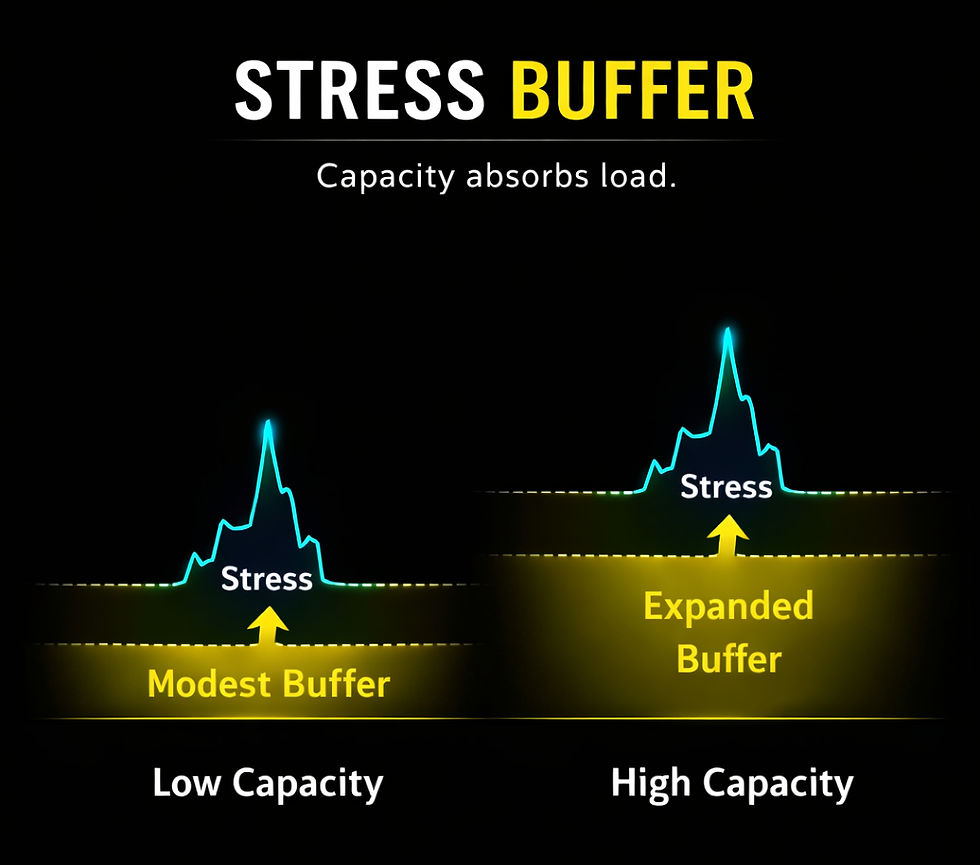
Most people focus on reducing stress.
Few focus on increasing capacity.
But adaptation is not just about lowering load.
It is about raising the ceiling.

What Is Recovery Capacity?
Recovery capacity is the body’s ability to:
• Regulate quickly
• Clear inflammation efficiently
• Restore energy rapidly
• Remodel tissue effectively
• Return to baseline fully
Higher capacity = faster completion of repair cycles.
Capacity Is Trainable
Just like strength, endurance, and skill — recovery can be trained.
Not randomly.
Systematically.

The Three Pillars of Capacity
1️⃣ Regulation Capacity
2️⃣ Clearance Capacity
3️⃣ Remodeling Capacity
If any pillar is weak, stress accumulates.
1️⃣ Regulation Capacity
The nervous system’s ability to shift from sympathetic activation to parasympathetic recovery.
High capacity looks like:
• Strong HRV (Heart Rate Variability)
• Stable sleep
• Faster heart rate normalization
• Emotional stability under load
Low capacity looks like:
• Persistent tension
• Poor sleep
• Elevated resting heart rate
• Delayed downshift
Regulation determines everything downstream.
2️⃣ Clearance Capacity
The body’s ability to:
• Move interstitial fluid
• Clear inflammatory byproducts
• Maintain efficient circulation
High capacity:
• Minimal lingering soreness
• Low swelling
• Efficient lymphatic flow
Low capacity:
• Persistent puffiness
• Slow soreness resolution
• Tissue congestion
Clearance determines whether repair completes.
3️⃣ Remodeling Capacity
The ability to rebuild:
• Muscle fibers
• Connective tissue
• Mitochondria
• Enzymatic systems
High capacity:
• Faster adaptation
• Improved strength-to-fatigue ratio
• Improved energy output
Low capacity:
• Repeated breakdown
• Plateau
• Chronic fatigue
Remodeling determines progress.

What Expands Capacity?
Consistency.
Not intensity.
The body expands capacity when it experiences:
• Repeated regulation signals
• Repeated clearance cycles
• Repeated remodeling completion
Capacity grows when cycles complete.
The Capacity Loop
Stress → Repair → Completion → Stronger Baseline
If completion occurs, baseline improves.
If completion fails, baseline rises (chronic load).
Capacity determines which path wins.
Signs You’re Expanding Capacity
• Faster recovery between sessions
• Less soreness accumulation
• Improved sleep quality
• Lower resting tension
• Higher performance with similar load
Why Most People Plateau
They increase stress faster than they increase capacity.
Training progresses.
Recovery does not.
Capacity becomes the bottleneck.
The Core Principle
Stress tolerance is not infinite.
But recovery capacity is expandable.
Build the system.
Not just the stimulus.
Closing Anchor
High performers don’t just train harder.
They expand recovery capacity.
That’s how stress becomes adaptation instead of accumulation.
Building Recovery Capacity: Frequently Asked Questions
Recovery capacity determines how efficiently your body completes stress-repair cycles. These answers explain how regulation, clearance, and remodeling improve long-term resilience and performance.
What is recovery capacity?
Recovery capacity is the body’s ability to regulate stress, clear inflammation, restore energy, and remodel tissue efficiently. Higher capacity means faster completion of repair cycles.
How is recovery capacity different from just resting?
Rest reduces immediate load. Recovery capacity improves how effectively the body completes repair and adapts to future stress.
Can recovery capacity be trained?
Yes. Recovery capacity expands through consistent regulation, repeated clearance cycles, and completed remodeling phases.
What improves nervous system regulation capacity?
Consistent sleep, breathwork, circadian stability, and structured recovery inputs improve parasympathetic strength and HRV.
How does lymphatic clearance affect recovery capacity?
Efficient clearance removes inflammatory byproducts and interstitial congestion. When clearance improves, repair cycles complete faster.
Why does remodeling capacity matter?
Remodeling determines whether stress leads to adaptation. Without adequate remodeling capacity, stress accumulates instead of building strength.
What are signs recovery capacity is increasing?
Faster recovery between sessions, improved sleep quality, reduced lingering soreness, higher HRV trends, and improved performance under similar load.
What limits recovery capacity?
Chronic stress stacking, sleep disruption, unresolved inflammation, poor circulation, and inconsistent recovery programming limit expansion.


